

Recipe
March 18, 2026
James MacGuire’s Chicken Liver Mousse
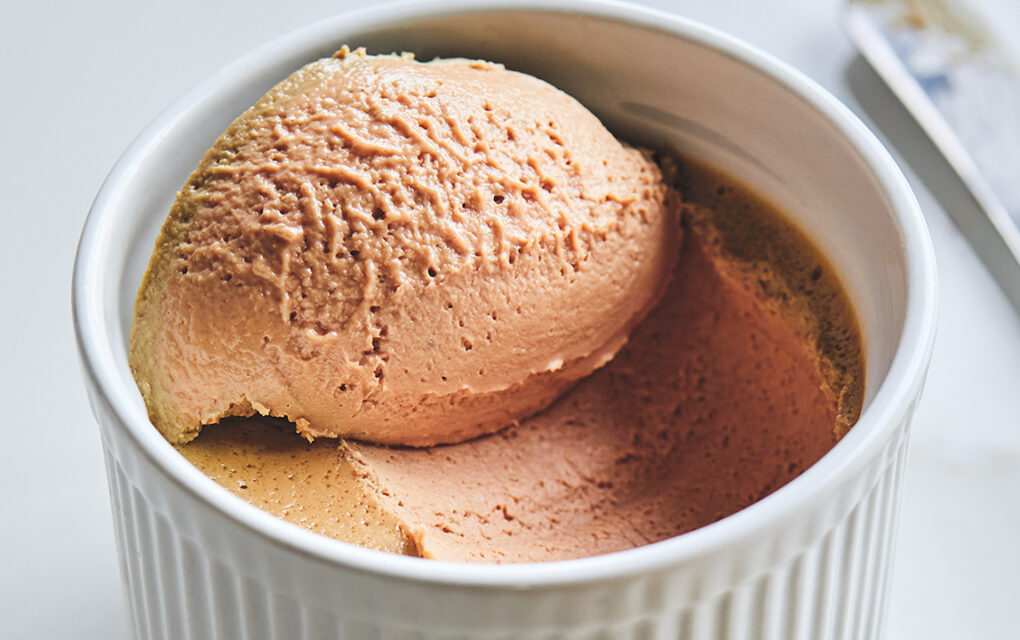
“I first tasted this divine mousse at the legendary Montreal restaurant Le Passe-Partout.” — Lesley Chesterman
Directions
Yield: Serves about 10
You’ll need: One 3″ x 4″ x 6″ terrine mould, plus two 2″ x 3″ ramekins. You can use ramekins of various sizes, but be sure to fill them to the same depth.
Make Mousse
- Preheat oven to 325°F. Set out baking pan large enough to hold moulds, place thin kitchen towel inside pan at bottom and put on full kettle of water to boil. A note about moulds: Choose a 2-to 2½-cup ceramic terrine mould that’s 3″ to 4″ deep in any shape you like. The mixture will be about 2″ deep, and the sides will rise a bit as it bakes. If you don’t intend to serve it all at once, you can use several smaller moulds. I usually make this in a small terrine mould and 2 ramekins of various sizes but all about the same depth.
- In saucepan, bring cream to a boil and keep it hot. In food processor, blend butter and duck fat.
- With food processor running, add livers 1 or 2 at a time, followed by egg yolks, 1 at a time. Stop and scrape down sides of bowl with spatula. With machine again running, and taking care not to splatter and burn yourself, gradually pour in hot cream, followed by cognac (or Armagnac), salt and pepper.
Bake Mousse
- Strain mixture into large measuring cup. Pour into mould (or moulds), place in baking pan, and pour in enough boiling water to come up to same level as mousse mixture inside. Place sheet of aluminum foil over pan and wrap edges around rim to seal.
- Carefully place into oven and bake for 25 to 30 minutes, or until internal temperature reads 165°F. The top of mixture should be convex but without cracks, and centre of mousse should be set. (Beware: If mousse is baked too long, the small amount of air in it will cause it to rise like a soufflé, with disastrous results.)
- Carefully remove pan from oven, then lift mould (or moulds) out of hot water. Immediately cover with plastic wrap, pressing lightly against surface of mousse to keep from oxidizing. Cool on rack, then refrigerate to chill completely before serving. Mousse will keep in refrigerator for up to 4 days.
Serve Mousse
- Scrape off and discard mottled surface from top of mousse and, with tablespoon dipped in very hot water, form into quenelle-shaped portions. Serve immediately.
Note: To accompany the mousse, James MacGuire suggests pickles and pain au levain (sourdough). I like croutons or toast points. As for wine, he prefers a Chenin moelleux from the Loire Valley, while I quite like this with a lightly chilled Beaujolais.
Maude Chauvin
Recipe from A Montreal Cook by Lesley Chesterman. Photography by Maude Chauvin. ©2026 by Lesley Chesterman. Excerpted with permission from Simon & Schuster Canada. All rights reserved

